Some Things That Don't Suck
UBI Good, UBISoft bad

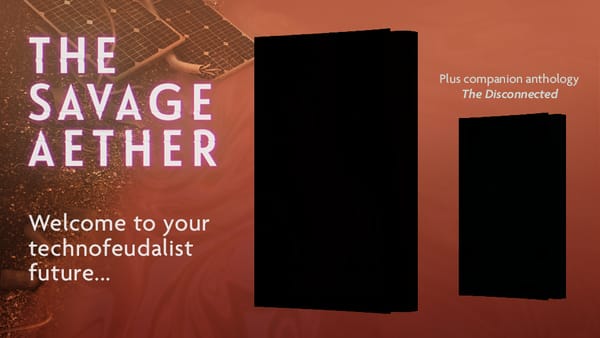
I have very exciting news! I have another book coming out! As a matter of fact, I have another two books coming out! The final details are getting nailed down, but they will be on Kickstarter very soon.
The first is a new novel, a cyberpunk story about a brother and sister making their way in just… the worst world. The second is a tie in anthology, which I put a call out for a few months back and I got some incredible submissions.
Keep an eye out, you’ll hear more soon!

Last months article was supposed to be a nice, affirming work that was talking about the positive aspects of community and stuff like that. Then some people were total dicks and I couldn’t in good conscience talk about anything else.
Unfortunately, that trend of awful stuff has kept going on, with Trump’s America doing its best to turn an industrialised nation into a feudal swamp, ongoing atrocities toward a whole raft of people, and enough other nonsense to make an Instagram feed a roulette of dog pictures and war crimes. If I continued to allow all the bad things in the world to dictate whether I could talk about good things my entire life would be misery and so would my writing. More so than it already is, anyway.
So here, this month I’m going to talk about a few things that don’t suck, some things I think are cool, and some things that I think if we follow, we can make the world a better place for one another.
It’ll probably do worse numbers than my rants, but them’s the breaks. Have some positivity, ya goons.
A Few Axioms I Believe to be true
Capitalism is Bad. Commerce is Good.
A little while ago, a friend of mine bought himself a drumkit. As is the way with thrifty musos who don’t do this for a day job, he was after a good deal. The seller was looking to shift it quickly and he (the buyer) was able to grab it at a pretty steep discount.
Cut to a few days later and he was telling us about it and he turned to me and said “Sorry, Henry. I know you hate capitalism.”
Now, two things:
- I know it was a joke, and a flippant remark that he didn’t think much about. I know, okay? No need to go off at me about taking the silly comment my friend made too seriously. I know it was a joke. That said…
- That’s not what Capitalism is!
Seriously, this is something I’ve heard quite a few times; the idea that Capitalism is when you buy stuff. And, uh, no. Moreover, buying stuff whips. If you want to, you can buy stuff from me! Buy from your friends as well! Swap your stuff for their stuff! That’s right, engage in barter, the OG commerce! I once sold a book in exchange for a caramel slice because my friend’s caramel slice is (allegedly) better than heroin, and after having it I’d believe her!
Seriously, this conflation of commerce, the act of two people engaging in a business transaction, and capitalism, which is a particular way of structuring economics, is something I get a bit wild about. When I say I’m anti-capitalist, I’m not saying that I don’t want you to have a nice TV and a 1000 thread count waifu pillow. It’s your money, buy your waifu pillows as you will.
Commerce has existed for a long time, in all cultures with a concept of ownership (Incidentally, the idea that people can “own” land is a concept I find very strange… maybe I’ll talk about it one day). Back in ancient days of yore, someone was trying to make whatever the prehistoric version of an apple strudel was, and swapped an ingredient for a nice rock they’d found on the ground, and boom! Commerce. This probably happened a quarter million years ago while we were still busy figuring out that putting fences around cows was way easier than chasing them all the time. Point is, commerce is about as old as anything humans do.
Capitalism, on the other hand? Very young. Arguments vary (see that one scene from Good Will Hunting) but basically at one point about two centuries ago someone made a factory for making widgets, then decided to get other people to come to the factory to make the widgets for them. The only way that person makes profit is by keeping their costs low, which incentivises the widget factory owner to pay the widget makers as little as possible. Many interesting and clever ways to get around paying the widget makers have been tried, and Capitalism on its own has no mechanism to stop the widget factory owner from treating the widget makers like dirt. Oh, sure, there are other jobs, but they’re all run by other widget factory owners with the same set of incentives, so payment for the “human resource” is a race to the bottom to find just how little a widget maker can survive on.
I’m not being flippant when I say I think Capitalism is evil. Every single thing that guarantees the non-wealthy aren’t left to starve or die from inhaling toxic fumes or work 15 hour days in the dark is something that has been fought for by forces that exist outside the free market.
We have minimum wages because if capitalism could pay us less, it would. We have PPE and safety requirements at worksites because if capitalism could avoid providing those things, it would. We have weekends because if capitalism had its way, we wouldn’t. We have child labour laws because if capitalism had its way, we’d all be in the mines as soon as we could pick up a pickaxe. We are constantly and always having to build walls around capitalism to stop it doing the shit that it is structurally incentivised to do.

We know this is true because before these safeguards all of these things happened. Read up on the Hawk’s Nest Mine disaster. Look at the above pictures of Belgian miners in the early 1900s. Hell, look at the collapse of the gaming industry and the way entire companies were liquidated in the last few years, or the way 100 hour weeks were normalised not long ago. Whenever possible, Capitalism squeezes humans for all their worth, and more. It just sucks, man.
So what makes what I’m calling “Commerce” any different?
The difference is neutrality of power. Capitalism forces you into a “you must take this job or starve” mindset, where not taking the job is an incredibly fraught prospect. When you are doing a commercial transaction, there should be none of that. Me selling you my book shouldn’t cause your financial ruin, and likewise you not buying it shouldn’t ruin me. Ideally. More on that later.
The other thing is the concept of the factory, and the ownership of the means of production. There’s this weird idea from people that under other economic systems (like socialism) you won’t own anything, but in fact you own more. Prior to the advent of factories during the industrial revolution, people had looms and spinning wheels and plows and gardens at their own houses, so they could make stuff on their own. Not only did you own your trinkets and things, but you owned the means of production. And no longer having that has truly caused a whole world of hurt.
The equivalent today for a lot of the work of the world is the computer1. I shared a post about divesting from predatory software companies recently, and I think that computer ownership is a great opportunity for many people to produce work of their own accord, and own their own means of production. Negotiate work that you want to do, when you want to do it, and do it with others who are doing the same. Engage in commerce, and do work according to your own standard, and do it well!
The thing that this kind of commerce avoids is twofold: It avoids a structural incentive to rip people off, because you don’t have employees doing the work that you can underpay. And secondly, you’re incentivised to do things to a high standard, because your product is what people will come back to, or will tell their friends about to get more. If you make a bad product, you’ll need to get better before people will trust you again. It’s not like the cheap kettle at Target that you have to replace every 18 months.
Commerce gets you a mixing bowl that you never have to replace for the rest of your life. Capitalism gets you ads on Netflix movies you don’t want to watch. Oh, and slavery, which is bad too, but not as bad as paying more for your chocolate, according to Nestle.
People are, by Their Nature, Industrious
You don’t have to look far to see newspaper stories decrying the existential laziness of today’s workforce. In 2022 the term “quiet quitting” started doing the rounds to describe a wage-earning worker who has the temerity to do their job as described and not work overtime or commit themselves to career burnout. Before that, it was claims that “nobody wants to work anymore”, or the idea that the new generation (usually the one directly below you, full of the verve for life that you used to have) don’t perform their tasts correctly. It’s a tale as old as time. In fact, you can go back to the 1800s and you’ll still be able to find examples of the phrase. It seems a constant and pervasive method of shaming the workforce. Kenneth Freeman, in a quote often attributed directly to Socrates, even talks about the attitude of the ancient greeks towards younger generations:
Children began to be the tyrants, not the slaves, of their households. They no longer rose from their seats when an elder entered the room; they contradicted their parents, chattered before company, gobbled up the dainties at table, and committed various offences against Hellenic tastes, such as crossing their legs.
Turns out, saying “you damn kids” and shaking your fist at the sky is just part of who we are, as is claiming that workers and children are lazy and indolent.
Well, I think it’s bullshit. People are industrious by their nature, and innate to everybody is the tendency to find joy in work. If you give people time and opportunity, they naturally start… doing stuff.
That stuff might not look like the waged labour that business owners and society demand from people, but there is industry. Baking, cleaning, working on cars, designing computers, creating art, writing blogs, pottery, anything. People just do stuff.
Even when it isn’t fun work, people tend to work when there’s a need. Volunteers pulling branches off people’s roofs after natural disasters, pushing a car down the road when the engine blows up. You see this kind of community during disasters or times of misfortune but it’s not limited to that. Bookstores moving locations and forming long lines of people passing books down the street from one location to the next is a meme at this point. Last year, my friend wanted to build an outdoor patio and about thirty of us volunteered to help. We just went and built the thing, made a whole day of it. I gotta tell you, sitting down at the end of the day under the shade of the fruits of our labour? I recommend feeling that satisfaction, eagerly and as often as you can.
So no, I don’t think that “nobody wants to work anymore.” I think that given even a modicum of dignity, people are amazing at getting what needs done, done. What I think people don’t like doing is work where they are underappreciated, underpaid, overstressed, and doing work that feels pointless or inane. I still haven’t read it, but the thesis of David Graeber’s Bullshit Jobs strikes a chord with me. Of course you don’t feel fulfilled if your job is producing reports summarising data you don’t care about to send to people who aren’t going to read it.
Also, in the event you’re in a bind, and you need to make a bit of money, you want to be able to go and do a job and get treated like a human being. I’ve been doing a bit of work on the side cleaning out old warehouses recently, and this really hit home for me. The work is hard; I spent a day breaking apart wooden palettes that had been abandoned for several years. By the time I got home, my blue jeans were dyed a shade of pale grey, I had sweated through my clothes, and I was covered in ground up dust made of several years of dried pigeon shit.
However, the guy I was working for was thankful, he bought me lunch, he paid me well, and he didn’t demand more from me than I was able to give. After a hard day’s work I was sent on my way. I’d work for him again, for sure.
And that’s the size of it, really. People want to work. People like helping out. People like making stuff. When they’re treated with dignity and rewarded appropriately, you’ll find that people don’t just want to work, they’ll fall over themselves to do so.
There Should be a Minimum Standard of Life Quality
In Australia, we have this thing called “minimum wage”. If you work full-time, it’s illegal for you to go home at the end of the week with less money than the minimum wage. It’s a fine idea, but I do often think to myself that it only works if you are working full-time (no guarantee, as even working a checkout at a supermarket has become more or less automated) or have a job at all.
I thought that a better idea would be to declare a minimum standard of living for people. A suite of ideals that identify what the worst condition in our society is allowed to be.
- A modest government apartment with necessary heating, cooling, bedding, a fridge, and a desk, with access to adequate daylight and air.
- An internet connection.
- A small computer or tablet suitable for emails and typical work requirements.
- Enough money for simple food that will fulfil nutritional needs.
- Enough funds for cleaning and sanitary products.
Here’s the kicker: You get this even if you don’t have a job.
In Australia, we have a homelessness problem. We have a housing problem. We have a workplace wage theft problem. We have a domestic violence problem. We have multiple concurrent crises, and it seems that all of them are driven by this fundamental gap between the minimum people need to survive and the increasing difficulty to achieve it.
I don’t think that if you give people their bare minimum requirements that they’ll stop working. As I said, people tend to work when its required. If people want to get more stuff, they can get a job (Bust crates for a few days and you can get a sweet new waifu pillow). But more importantly than that, they’ll be able to leave a job that’s exploiting them. They’ll be able to leave a husband who is violent. They won’t be relegated to underfeeding themselves. They won’t be unable to get a job for lack of an internet connection. Instead, we’ll have a standard of minimum dignity for every person who shares our society.
There’s economic arguments about this, and I know there is, but for every one I’ve heard I’ve also heard a refutation, and quite frankly, I’m sick of the status quo. I think we can do better, and I want to see the kind of amazing work we can do when most of us are wondering how to keep a roof over our heads.
And I may be naive about this, but I’d rather be naive than nihilistic.
This newsletter is an independent publication that only exists because of readers like you. If you get value from reading these articles, I’d appreciate a pledge of support for just AUD$5 per month, or AUD$30 per year. Otherwise, feel free to share it with your friends or network, or leave a comment if you enjoy it.
For those who are already supporting, thank you so much. It means a lot.
I know this pushes the production problem back one step to the manufacture of computer parts, but employee-owned companies are possible as well, and maybe one of those employees could tell Jensen Huang he’s an idiot. ↩